
Understand the 8 Stages of Emotional & Social Growth
🌟 Short Introduction
When CTET asks questions on emotional development, identity, or social behaviour, it’s almost always based on Erik Erikson’s 8-stage psychosocial theory.
But many aspirants only memorize the stages and forget the core idea:
📌 Every stage has a conflict — and how the child resolves it shapes personality.
This post simplifies all 8 stages using easy examples, teacher-friendly explanations, and CTET-focused hints.
🎯 By the end, you’ll remember every stage clearly and answer any Erikson question with confidence.
🧠 Erikson’s Theory of Psychosocial Development
Erikson believed:
Children grow through eight stages, and each stage has a psychosocial conflict that must be balanced for healthy development.
Each conflict has:
- A positive outcome (healthy trait)
- A negative outcome (difficulty or doubt)
Let’s understand the stages simply:
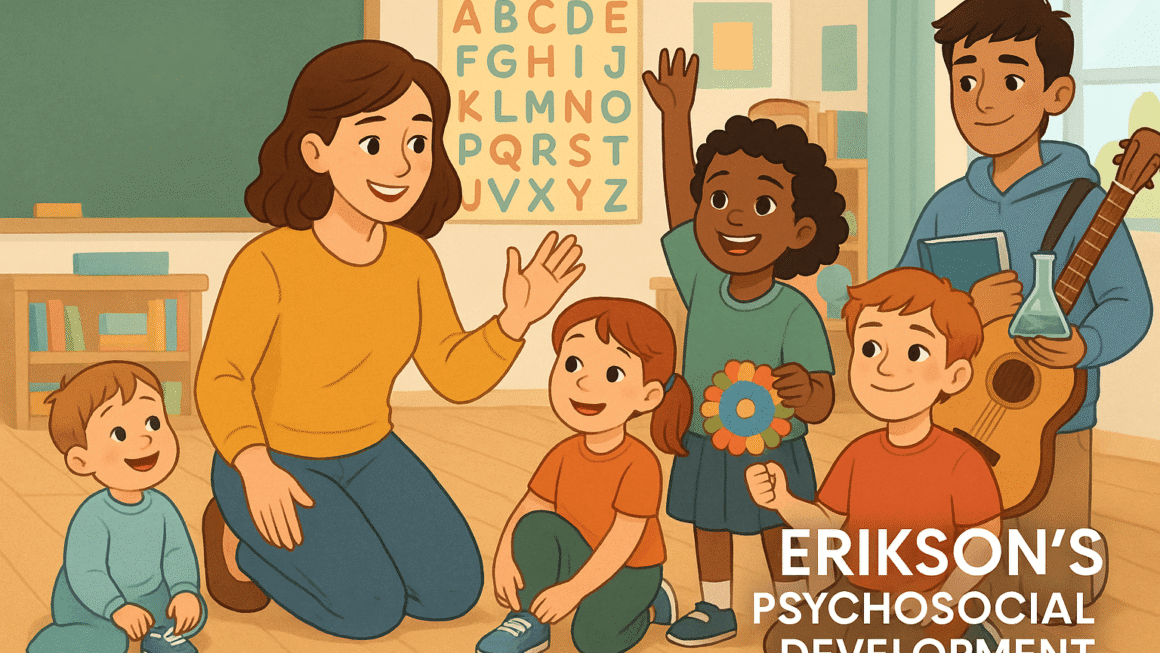
🧩 Erikson’s 8 Stages – With CTET Classroom Examples
| Stage | Age | Conflict | What It Means | Classroom Example |
| 1. Trust vs Mistrust | 0–1 yr | Developing trust | Babies feel secure when needs are met | A child stops crying when the caregiver responds quickly |
| 2. Autonomy vs Shame | 1–3 yrs | Independence | Children want to do things themselves | A toddler tries to wear shoes alone; teacher encourages |
| 3. Initiative vs Guilt | 3–6 yrs | Taking initiative | Children start planning and leading activities | A child volunteers to distribute notebooks |
| 4. Industry vs Inferiority | 6–12 yrs | Skill development | Children want to do tasks well and be praised | A student proudly shows neat handwriting or crafts |
| 5. Identity vs Role Confusion | 12–18 yrs | Identity formation | Adolescents explore “Who am I?” | Teen chooses hobbies, career interests, friend groups |
| 6. Intimacy vs Isolation | Young adult | Forming close relationships | Building friendships/bonds | College student forms deep friendships |
| 7. Generativity vs Stagnation | Adult | Giving back to society | Contributing, mentoring | Parent/teacher supports younger generation |
| 8. Integrity vs Despair | Old age | Life reflection | Feeling satisfied or regretful | Elder sharing life experiences with confidence |
🔶 Don’t Confuse: Identity vs Role Confusion (Most Asked in CTET!)
This is Erikson’s most popular CTET question.
📌 Identity = “I know who I am.”
📌 Role Confusion = “I don’t know what I want to become.”
CTET example question:
“During adolescence, which crisis is most prominent?”
Answer → Identity vs Role Confusion
👩🏫 Classroom Implications (CTET Pedagogy Angle)
Erikson strongly influences classroom practice. Here’s how a CTET teacher applies these stages:
✔ Encourage independence (Autonomy stage)
Let children tie their laces, open lunch boxes, arrange materials.
✔ Provide appreciation (Industry stage)
Praise effort, not just accuracy.
✔ Support identity formation (Adolescent stage)
Help students explore strengths, interests, and goals.
✔ Build trust (Early childhood)
Create a safe and predictable classroom routine.
✔ Avoid shame/guilt
Never mock mistakes — guide gently.
These CTET questions often start with phrases like:
“Teacher should allow child to take responsibility…” → Autonomy vs Shame
🧵 Memory Trick – “T A I I I G I” (Read as: TAI-IGI)
A super-easy way to remember stages:
T – Trust
A – Autonomy
I – Initiative
I – Industry
I – Identity
G – Generativity
I – Integrity
OR remember as:
“TAI – 3Is – GI”
Once you know this sequence → stage ages become easy to recall.
🧩 Mini Quiz – Test Your CTET Concept
- Erikson’s theory focuses on—
a) Moral development b) Cognitive development c) Psychosocial development d) Emotional conditioning
✅ Answer: c) Psychosocial development - “Who am I?” is the crisis of which stage?
a) Initiative vs Guilt b) Identity vs Role Confusion c) Autonomy vs Shame d) Industry vs Inferiority
✅ Answer: b) Identity vs Role Confusion - Encouraging children to try tasks independently supports which stage?
a) Trust vs Mistrust b) Autonomy vs Shame c) Integrity vs Despair d) Generativity vs Stagnation
✅ Answer: b) Autonomy vs Shame - Appreciating a child’s neat work falls under—
a) Industry vs Inferiority b) Initiative vs Guilt c) Trust vs Mistrust d) Integrity vs Despair
✅ Answer: a) Industry vs Inferiority - A baby feeling secure when needs are met is part of—
a) Industry b) Trust c) Autonomy d) Guilt
✅ Answer: b) Trust
🧩 Final Takeaway
Erikson helps teachers understand how emotions and social experiences shape children.
- Babies need trust
- Young children need independence
- Primary students need encouragement
- Adolescents need identity support
A great CTET teacher balances care + independence + guidance across all stages.
💬 Keep understanding your learners. Keep teaching smart.
Stay Concept-Strong. Stay Certified. #CTETSmart
हिंदी संस्करण (Hindi Version)
नीचे पूरे लेख का हिंदी अनुवाद पढ़ें –
एरिक्सन का मनोसामाजिक विकास सिद्धांत – CTET नोट्स व क्लासरूम उदाहरण
बच्चों के सामाजिक-भावनात्मक विकास के 8 चरणों को सरल भाषा में समझें
🌟 संक्षिप्त परिचय
CTET में जब भी भावनात्मक विकास, पहचान (Identity) या सामाजिक व्यवहार से जुड़े प्रश्न आते हैं — वे अधिकतर Erik Erikson के 8-स्टेज मनोसामाजिक सिद्धांत पर आधारित होते हैं।
लेकिन अधिकतर छात्र केवल स्टेज याद करते हैं…
और मुख्य विचार भूल जाते हैं:
📌 हर चरण में एक संघर्ष (Conflict) होता है — और बच्चे इसे कैसे हल करते हैं, इससे व्यक्तित्व बनता है।
यह पोस्ट इस सिद्धांत को आसान भाषा, स्पष्ट उदाहरणों, और CTET-केन्द्रित बिंदुओं से समझाती है।
🎯 अंत तक आप एरिक्सन के सभी चरणों को आसानी से याद रख पाएँगे और कोई भी CTET प्रश्न हल कर सकेंगे।
🧠 एरिक्सन का मनोसामाजिक विकास सिद्धांत
एरिक्सन के अनुसार—
बच्चे जन्म से वृद्धावस्था तक 8 चरणों से गुजरते हैं, और हर चरण में एक सामाजिक-भावनात्मक संघर्ष होता है जिसे संतुलित ढंग से हल करना आवश्यक है।
हर चरण में होता है:
- एक सकारात्मक परिणाम (सशक्त गुण)
- एक नकारात्मक परिणाम (संदेह या कठिनाई)
चलिए इसे सरल उदाहरणों के साथ समझते हैं:
🧩 एरिक्सन के 8 चरण – CTET के लिए सरल तालिका
| चरण (Stage) | आयु | संघर्ष (Conflict) | अर्थ | कक्षा का उदाहरण |
|---|---|---|---|---|
| 1. Trust vs Mistrust | 0–1 वर्ष | भरोसा बनाम अविश्वास | बच्चे सुरक्षा महसूस करना सीखते हैं | बच्चा रोता है और केयरगिवर तुरंत प्रतिक्रिया देता है → भरोसा बनता है |
| 2. Autonomy vs Shame | 1–3 वर्ष | स्वायत्तता बनाम शर्म | बच्चे खुद से काम करना चाहते हैं | बच्चा खुद जूते पहनने की कोशिश करता है; शिक्षक हौसला बढ़ाता है |
| 3. Initiative vs Guilt | 3–6 वर्ष | पहल बनाम अपराधबोध | बच्चे गतिविधियाँ शुरू करना चाहते हैं | बच्चा खड़ा होकर बोलता है – “मैं कॉपियाँ बाँटूँगा!” |
| 4. Industry vs Inferiority | 6–12 वर्ष | कौशल विकास बनाम हीनभावना | बच्चे अच्छे काम का गर्व महसूस करना चाहते हैं | बच्चा अपनी साफ-सुथरी कॉपी गर्व से दिखाता है |
| 5. Identity vs Role Confusion | 12–18 वर्ष | पहचान बनाम भ्रम | किशोर “मैं कौन हूँ?” जैसे प्रश्नों पर सोचते हैं | किशोर अपने करियर या रुचियाँ खोजता है – संगीत/विज्ञान/खेल |
| 6. Intimacy vs Isolation | युवावस्था | गहरे संबंध बनाना | दोस्ती व संबंध बनाना सीखता है | कॉलेज में अच्छे मित्र बनाना |
| 7. Generativity vs Stagnation | वयस्कता | समाज में योगदान | अगली पीढ़ी को मार्गदर्शन देना | शिक्षक या माता-पिता बच्चों का मार्गदर्शन करते हैं |
| 8. Integrity vs Despair | वृद्धावस्था | जीवन का मूल्यांकन | संतोष या पछतावा | बुजुर्ग अपने अनुभव आत्मविश्वास से साझा करते हैं |
🔶 Don’t Confuse: Identity vs Role Confusion (CTET में सबसे ज़्यादा पूछा जाता है!)
📌 Identity = “मैं कौन हूँ?” का स्पष्ट उत्तर
📌 Role Confusion = “मुझे समझ नहीं आ रहा कि मैं क्या बनूँ?”
CTET उदाहरण प्रश्न:
किशोर अवस्था में प्रमुख संघर्ष क्या होता है?
✔ Identity vs Role Confusion
👩🏫 कक्षा में एरिक्सन के सिद्धांत का प्रयोग – CTET Pedagogy दृष्टिकोण
✔ स्वायत्तता को बढ़ावा दें (Autonomy Stage)
बच्चों को छोटे-छोटे काम खुद करने दें — जूते पहनना, बैग व्यवस्थित करना।
✔ प्रशंसा देकर कौशल बढ़ाएँ (Industry Stage)
सिर्फ सही उत्तर नहीं, प्रयास की भी सराहना करें।
✔ किशोरों को पहचान बनाने में मदद करें (Identity Stage)
उनकी रुचियों, ताकतों और लक्ष्यों पर चर्चा कराएँ।
✔ विश्वास भरा माहौल बनाएँ (Trust Stage)
कक्षा की दिनचर्या स्पष्ट रखें।
✔ शर्म और अपराधबोध से बचाएँ
गलती पर मज़ाक न करें — मार्गदर्शन दें।
CTET में अक्सर ऐसे प्रश्न आते हैं:
“शिक्षक को बच्चे को जिम्मेदारी क्यों देनी चाहिए?”
→ Autonomy vs Shame
🧵 Memory Trick – “TAI-III-GI”
Stages याद रखने का आसान तरीका:
T – Trust
A – Autonomy
I – Initiative
I – Industry
I – Identity
G – Generativity
I – Integrity
इसे ऐसे याद रखें: “TAI – 3 I’s – GI”
🧩 Mini Quiz – अपनी समझ जाँचें
- एरिक्सन का सिद्धांत किस पर केंद्रित है?
a) नैतिक विकास b) संज्ञानात्मक विकास c) मनोसामाजिक विकास d) भावात्मक कंडीशनिंग
✅ उत्तर: c) मनोसामाजिक विकास - “मैं कौन हूँ?” किस चरण का संघर्ष है?
a) Initiative vs Guilt b) Identity vs Role Confusion c) Autonomy vs Shame d) Industry vs Inferiority
✅ उत्तर: b) Identity vs Role Confusion - बच्चों को खुद छोटे काम करने देना किस चरण को मजबूत करता है?
a) Trust b) Autonomy c) Integrity d) Generativity
✅ उत्तर: b) Autonomy - साफ-सुथरा काम दिखाने पर प्रशंसा करना किस चरण से जुड़ा है?
a) Industry vs Inferiority b) Initiative vs Guilt c) Trust vs Mistrust d) Integrity vs Despair
✅ उत्तर: a) Industry vs Inferiority - caregiver की तुरंत प्रतिक्रिया से बच्चा किस गुण को सीखता है?
a) Industry b) Trust c) Autonomy d) Initiative
✅ उत्तर: b) Trust
🧩 Final Takeaway (अंतिम सार)
एरिक्सन हमें सिखाते हैं कि बच्चे भावनात्मक + सामाजिक अनुभवों से विकसित होते हैं।
- शिशु को भरोसा चाहिए
- छोटे बच्चों को स्वतंत्रता
- प्राथमिक बच्चों को प्रशंसा
- किशोरों को पहचान बनाने का अवसर
एक अच्छा CTET शिक्षक इन सभी जरूरतों को समझकर पढ़ाता है।
💬 सीखते रहें, सिखाते रहें।
Stay Concept-Strong. Stay Certified. #CTETSmart