
Understand the Concept of Inclusion and How to Support Every Child in Your Classroom
🌟 Short Introduction
In a real classroom, no two children learn the same way. Some grasp quickly, others need more time, and a few require special support.
That’s where Inclusive Education comes in — a cornerstone concept in CTET and in modern classrooms.
It’s not just a topic for the exam; it’s a mindset every teacher must adopt to ensure “Education for All.”
🎯 By the end of this guide, you’ll understand what inclusion really means, NCERT’s latest guidelines, and how to create inclusive classrooms effectively.
🧩 What is Inclusive Education?
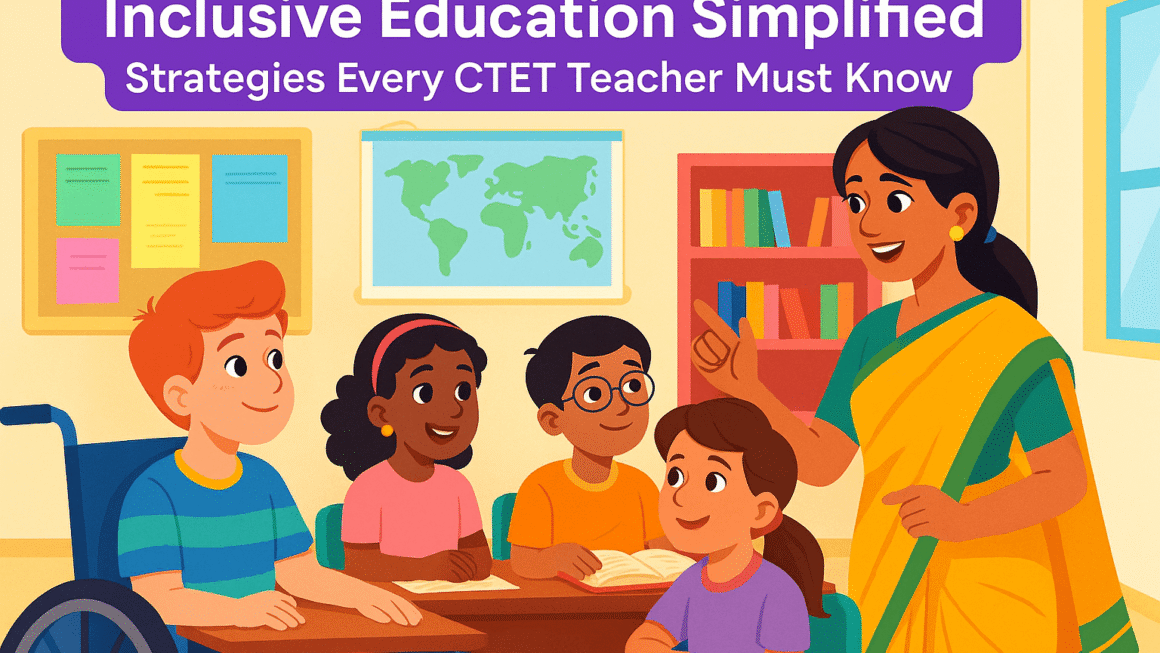
Inclusive Education means providing equal learning opportunities to all students, regardless of their differences — physical, mental, social, economic, or linguistic.
It’s about removing barriers so every child can learn together in the same classroom.
| Term | Meaning | CTET Example |
| Integration | Placing students with disabilities in regular schools without changing teaching methods. | A child with low vision sits in a regular class, but the teacher doesn’t adapt materials. |
| Inclusion | Adjusting environment, teaching, and support so every child can succeed. | Teacher provides large print material and peer help for visually impaired students. |
📘 Core Principles of Inclusive Education
| Principle | Explanation | CTET Example / Application |
| Equity, not Equality | Every child gets what they need to succeed. | Using extra time for a child with dyslexia during tests. |
| Respect for Diversity | Accepting all learning styles, abilities, and cultures. | Including local language in early learning. |
| Participation | Every child participates actively in all school activities. | Mixed-group projects involving all students. |
| Collaboration | Teachers, parents, and special educators work together. | Teacher consults resource teacher for individualized plans. |
👩🏫 Inclusive Teaching Strategies (For CTET Pedagogy Questions)
- Differentiated Instruction:
Adjust lessons to suit visual, auditory, and kinesthetic learners.
Example: Using flashcards, group reading, and role-plays in one lesson. - Peer Tutoring:
Pair stronger students with those who need help — builds empathy and support. - Use of Assistive Technology:
Audio books, screen readers, enlarged text, and tactile learning aids. - Continuous Evaluation:
Replace high-pressure exams with projects, observations, and oral testing. - Positive Reinforcement:
Praise effort and progress, not just marks — builds confidence. - IEP (Individualized Education Plan):
Tailored learning goals for children with special needs, designed collaboratively by teachers and parents.
📗 Role of the Teacher in an Inclusive Classroom
| Teacher Role | Practical Action |
| Facilitator | Designs flexible lesson plans and uses multi-sensory teaching. |
| Observer | Identifies learning challenges early through observation. |
| Collaborator | Works with parents, resource teachers, and counselors. |
| Motivator | Builds a positive and accepting classroom environment. |
| Evaluator | Assesses progress holistically, not just academic results. |
🧠 Types of Learners and Support Strategies
| Learner Type | Common Challenges | Support Strategy |
| Visually Impaired | Reading from board | Use large fonts, tactile aids, and verbal cues. |
| Hearing Impaired | Following oral instructions | Use sign language, written notes, and gestures. |
| Learning Disability (e.g., Dyslexia) | Reading, spelling issues | Use phonics-based methods and extended time. |
| ADHD | Concentration issues | Use short activities and positive redirection. |
| Gifted Learners | Boredom with regular pace | Provide enrichment tasks and leadership roles. |
🧩 Mini Quiz – Test Your Understanding
1. Inclusive education means—
a) Teaching all students the same way
b) Adjusting teaching for diverse needs
c) Teaching only special children
d) Separate schooling
✅ Answer: b) Adjusting teaching for diverse needs
2. NEP 2020 emphasizes—
a) Rote learning
b) Standardization
c) Inclusion and flexibility
d) Competitive exams
✅ Answer: c) Inclusion and flexibility
3. What does IEP stand for?
a) Individual Examination Plan
b) Inclusive Education Policy
c) Individualized Education Plan
d) Inclusive Examination Programme
✅ Answer: c) Individualized Education Plan
🧩 Final Takeaway
Inclusive Education isn’t just a CTET topic — it’s the heart of effective teaching.
It reminds us that every child can learn — just not on the same day or in the same way.
When you teach with empathy and flexibility, you don’t just teach better — you teach smarter.
💬 Promote Inclusion. Build Understanding. #CTETSmart
हिंदी संस्करण (Hindi Version)
नीचे पूरे लेख का हिंदी अनुवाद पढ़ें –
समावेशी शिक्षा सरल रूप में – प्रत्येक CTET शिक्षक को जानने योग्य रणनीतियाँ
समावेशी शिक्षा की अवधारणा और हर बच्चे को कक्षा में सहयोग देने के व्यावहारिक तरीके जानें
🌟 संक्षिप्त परिचय
वास्तविक कक्षा में कोई भी दो बच्चे एक जैसे नहीं सीखते।
कुछ बच्चे जल्दी समझ लेते हैं, कुछ को थोड़ा समय लगता है,
और कुछ को विशेष सहयोग (special support) की आवश्यकता होती है।
यही वह जगह है जहाँ समावेशी शिक्षा (Inclusive Education) की भूमिका शुरू होती है —
जो न केवल CTET के लिए बल्कि आधुनिक शिक्षण का एक आधारभूत सिद्धांत है।
यह सिर्फ परीक्षा का विषय नहीं है;
यह हर शिक्षक की सोच (Mindset) होनी चाहिए ताकि “हर बच्चे के लिए शिक्षा” सच में संभव हो सके।
🎯 इस गाइड के अंत तक आप जानेंगे:
• समावेशी शिक्षा का वास्तविक अर्थ क्या है
• NCERT की नवीनतम गाइडलाइंस क्या कहती हैं
• और कक्षा में समावेशी वातावरण कैसे बनाया जा सकता है
🧩 समावेशी शिक्षा क्या है?
समावेशी शिक्षा का अर्थ है —
सभी विद्यार्थियों को समान सीखने के अवसर प्रदान करना,
भले ही वे शारीरिक, मानसिक, सामाजिक, आर्थिक या भाषाई दृष्टि से एक-दूसरे से भिन्न क्यों न हों।
इसका उद्देश्य है —
सीखने में आने वाली बाधाओं (barriers) को हटाना ताकि हर बच्चा एक ही कक्षा में, साथ मिलकर सीख सके।
| शब्द | अर्थ | CTET उदाहरण |
|---|---|---|
| एकीकरण (Integration) | विशेष आवश्यकता वाले बच्चों को सामान्य विद्यालयों में रखना, लेकिन शिक्षण पद्धति नहीं बदलना | कम दृष्टि वाला बच्चा सामान्य कक्षा में बैठता है, लेकिन शिक्षक सामग्री में बदलाव नहीं करते। |
| समावेशन (Inclusion) | शिक्षण पद्धति, वातावरण और सहयोग को इस तरह अनुकूलित करना कि हर बच्चा सफल हो सके | शिक्षक दृष्टिबाधित बच्चे के लिए बड़े अक्षरों में सामग्री देते हैं और सहपाठी सहायता प्रदान करते हैं। |
📘 समावेशी शिक्षा के मूल सिद्धांत
| सिद्धांत | व्याख्या | CTET उदाहरण / अनुप्रयोग |
|---|---|---|
| समानता नहीं, न्याय (Equity, not Equality) | हर बच्चे को उसकी आवश्यकता के अनुसार अवसर मिलना चाहिए | डिस्लेक्सिया वाले बच्चे को परीक्षा में अतिरिक्त समय देना |
| विविधता का सम्मान (Respect for Diversity) | सभी सीखने की शैलियों, क्षमताओं और संस्कृतियों को स्वीकार करना | प्रारंभिक शिक्षा में स्थानीय भाषा को शामिल करना |
| भागीदारी (Participation) | हर बच्चे की विद्यालय गतिविधियों में सक्रिय भागीदारी | सभी विद्यार्थियों को शामिल करते हुए समूह परियोजना |
| सहयोग (Collaboration) | शिक्षक, माता-पिता और विशेष शिक्षकों का सामूहिक प्रयास | शिक्षक व्यक्तिगत योजना (IEP) बनाने के लिए संसाधन शिक्षक से परामर्श करता है |
👩🏫 समावेशी शिक्षण रणनीतियाँ (CTET शिक्षाशास्त्र के लिए उपयोगी)
1️⃣ विभेदित शिक्षण (Differentiated Instruction):
कक्षा में दृश्य (Visual), श्रवण (Auditory) और क्रियात्मक (Kinesthetic) विद्यार्थियों के लिए अलग-अलग गतिविधियाँ शामिल करें।
उदाहरण: फ्लैशकार्ड, समूह पठन, रोल-प्ले एक ही पाठ में शामिल करना।
2️⃣ सहपाठी शिक्षण (Peer Tutoring):
मजबूत छात्रों को सहायता की आवश्यकता वाले छात्रों के साथ जोड़ें — यह सहानुभूति और समर्थन विकसित करता है।
3️⃣ सहायक प्रौद्योगिकी (Assistive Technology):
ऑडियो बुक्स, स्क्रीन रीडर, बड़े अक्षर वाले टेक्स्ट, और स्पर्श आधारित (tactile) शिक्षण सामग्री का प्रयोग करें।
4️⃣ सतत मूल्यांकन (Continuous Evaluation):
अधिक दबाव वाली परीक्षाओं के स्थान पर परियोजनाएँ, अवलोकन, और मौखिक मूल्यांकन अपनाएँ।
5️⃣ सकारात्मक सुदृढीकरण (Positive Reinforcement):
केवल अंकों की नहीं, बल्कि प्रयास और प्रगति की प्रशंसा करें — आत्मविश्वास बढ़ता है।
6️⃣ व्यक्तिगत शिक्षा योजना (IEP – Individualized Education Plan):
विशेष आवश्यकता वाले बच्चों के लिए व्यक्तिगत लक्ष्य निर्धारित करें —
शिक्षक, अभिभावक और संसाधन शिक्षक मिलकर तैयार करें।
📗 समावेशी कक्षा में शिक्षक की भूमिका
| भूमिका | व्यावहारिक कार्य |
|---|---|
| सुविधादाता (Facilitator) | लचीले पाठ योजनाएँ बनाना और बहु-संवेदी (multi-sensory) शिक्षण पद्धति अपनाना। |
| प्रेक्षक (Observer) | विद्यार्थियों की सीखने की कठिनाइयों को शीघ्र पहचानना। |
| सहयोगी (Collaborator) | अभिभावकों, संसाधन शिक्षकों और परामर्शदाताओं से सहयोग करना। |
| प्रेरक (Motivator) | सकारात्मक और स्वीकार्य कक्षा वातावरण बनाना। |
| मूल्यांकनकर्ता (Evaluator) | शैक्षणिक के साथ-साथ भावनात्मक और सामाजिक प्रगति का मूल्यांकन करना। |
🧠 सीखने वाले बच्चों के प्रकार और सहायता रणनीतियाँ
| विद्यार्थी का प्रकार | सामान्य चुनौतियाँ | सहायता रणनीति |
|---|---|---|
| दृष्टिबाधित | बोर्ड से पढ़ने में कठिनाई | बड़े अक्षरों, स्पर्श आधारित सामग्री और मौखिक संकेतों का उपयोग करें। |
| श्रवण बाधित | मौखिक निर्देशों को समझने में कठिनाई | सांकेतिक भाषा, लिखित नोट्स और इशारों का प्रयोग करें। |
| सीखने में अक्षमता (जैसे डिस्लेक्सिया) | पढ़ने, लिखने, स्पेलिंग में कठिनाई | फोनेटिक्स-आधारित विधि और अतिरिक्त समय दें। |
| ADHD वाले बच्चे | ध्यान केंद्रित करने में कठिनाई | छोटी गतिविधियाँ और सकारात्मक ध्यान-आकर्षण विधियाँ अपनाएँ। |
| प्रतिभाशाली विद्यार्थी (Gifted Learners) | सामान्य गति से बोरियत | उन्हें अतिरिक्त कार्य, नेतृत्व भूमिकाएँ और सृजनात्मक कार्य दें। |
🧩 मिनी क्विज़ – अपनी समझ जाँचें
1️⃣ समावेशी शिक्षा का अर्थ है —
a) सभी बच्चों को एक जैसा पढ़ाना
b) विविध आवश्यकताओं के अनुसार शिक्षण को अनुकूलित करना
c) केवल विशेष बच्चों को पढ़ाना
d) अलग विद्यालय बनाना
✅ उत्तर: b) विविध आवश्यकताओं के अनुसार शिक्षण को अनुकूलित करना
2️⃣ राष्ट्रीय शिक्षा नीति (NEP) 2020 जोर देती है —
a) रटने पर
b) एकरूपता पर
c) समावेशन और लचीलापन पर
d) प्रतिस्पर्धात्मक परीक्षाओं पर
✅ उत्तर: c) समावेशन और लचीलापन पर
3️⃣ IEP का पूर्ण रूप क्या है?
a) Individual Examination Plan
b) Inclusive Education Policy
c) Individualized Education Plan
d) Inclusive Examination Programme
✅ उत्तर: c) Individualized Education Plan
🧩 अंतिम निष्कर्ष
समावेशी शिक्षा केवल CTET का एक विषय नहीं — यह प्रभावी शिक्षण का मूल आधार है।
यह हमें याद दिलाती है कि —
हर बच्चा सीख सकता है,
बस सभी बच्चे एक ही दिन या एक ही तरीके से नहीं सीखते।
जब आप सहानुभूति और लचीलापन के साथ पढ़ाते हैं,
तो आप केवल बेहतर शिक्षक नहीं बनते — आप स्मार्ट शिक्षक बनते हैं।
💬 Inclusion को बढ़ावा दें। समझ विकसित करें। #CTETSmart